The Lab Reports
Welcome to the Lab Reports, where we pull back the curtain on the Mission Architecture driving the next generation of digital growth. These aren't your typical marketing musings; they are structural deep dives into the intersection of brand authority, technical automation, and high-stakes strategy. Each report is designed to move you past the "gadget phase" of digital tools and toward a future-ready ecosystem built on clean data and intentional workflows. We’re here to bridge the gap between high-level vision and tactical execution, providing the blueprints you need to turn your digital presence into a load-bearing business asset.

If Your Customers Don’t Start on Your Website, What Is It Actually For?
It is easy to assume you have a traffic problem. You might start looking at expensive ads or search hacks to get more eyes on the page. For most small businesses, that isn't the real issue. The problem is that we still treat a website like a digital front door for strangers. That isn’t how it works anymore.

Is your website designed to convert?
Design is important to the success of your communication efforts, but it may not be what you think. Often, design is confused with aesthetic. Both are important, but they serve different functions. Design is the structure. Think of it as the floor plan to your new house. While aesthetics is the paint colors and furniture. The design guides your visitors through the journey to becoming a customer. The aesthetic creates the emotional connection to your company.
Which is better for B2B: Webflow or Wordpress?
Most B2B companies think the decision between Webflow and WordPress comes down to flexibility or cost, but that’s not where projects succeed or fail. The real difference is how each platform supports clarity, scalability, and the ability to iterate without friction. WordPress offers deep flexibility and a massive ecosystem, but that often comes with plugin bloat, maintenance overhead, and reliance on developers for even simple changes. Webflow, by contrast, prioritizes control at the design and content level, giving teams more autonomy to move quickly—but it only works if the underlying strategy is sound. The better question isn’t which platform is more powerful. It’s which one supports a system your team can actually manage, evolve, and use to drive conversion over time.
Can AI Replace Web Designers for B2B Websites?
AI can generate a website in minutes, but it can’t tell you what the site is supposed to do. Most AI tools focus on speed and surface-level structure—layouts, copy blocks, and basic flows—but they don’t understand positioning, buyer intent, or how to guide someone from first impression to decision. The result is usually a site that looks complete but lacks clarity, direction, and differentiation. A web designer’s role isn’t to assemble pages anymore, it’s to define the system behind them—how messaging, structure, and experience work together to drive action. AI can accelerate production, but without strategy, it just helps you publish confusion faster.

Why do site visitors leave my site so quickly?
Prospective customers do not understand what a business does or what they are supposed to do on the website. This is because the site uses insider jargon, has weak calls to action, or has a confusing layout. This failure to provide a clear path leads to high bounce rates and low conversion rates among interested visitors.

Does inconsistent or generic messaging confuse potential customers and weaken brand perception?
Potential clients encounter different descriptions of the business and its value across various platforms. The brand lacks a unique point-of-view, or different departments create their own mismatched communications. This undermines trust, forces competition based on price, and slows growth by making the business indistinguishable from competitors.

How often do I need to update my website?
Too many businesses treat their website like a car—they only take it to the shop when the engine starts smoking. That's a reactive strategy, and it's costing you growth.

Why Isn’t My Website Converting?
Most websites don’t fail because of bad design or weak copy. They fail because visitors can’t quickly understand what to do next. When the path isn’t clear, people don’t figure it out. They leave.
Sinking in the “Next Big Thing”
Every morning there is a new AI tool, a new "must-have" platform, and a new expert telling you that you’re already behind. You’ve bought the software. You’ve sat through the demos. But your data is still a mess, your tools don’t talk to each other, and you’re pretty sure you’re only using 10% of what you’re paying for.

Fragmentation Fatigue
You’re doing everything right. You’re on LinkedIn. You’re sending the emails. You’re tweaking the SEO. You are working harder than ever, yet the needle isn't moving. It feels like you’re throwing spaghetti at a digital wall, and nothing—not even the expensive stuff—is sticking.
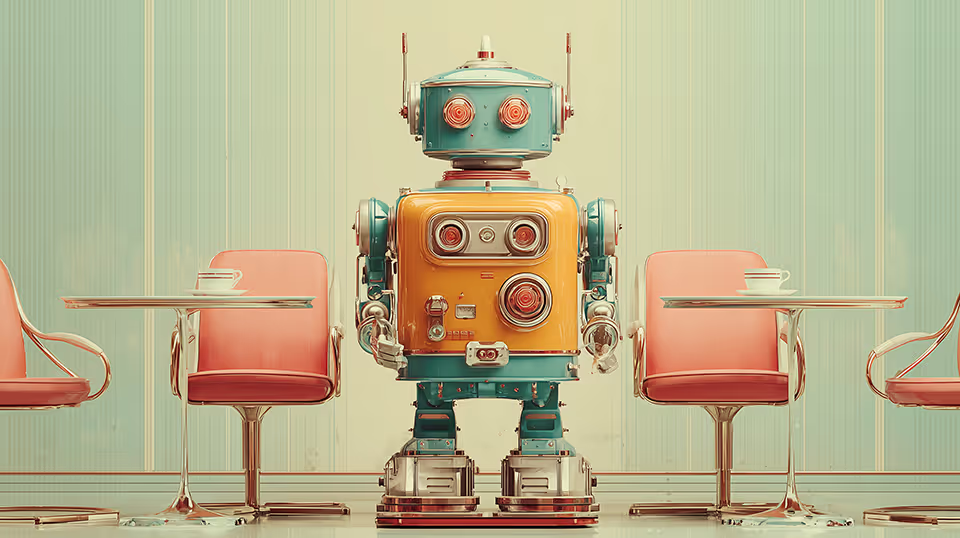
The Ghost in the Machine
It’s an uncomfortable feeling: realizing your business is starting to sound like a robot. You started your company because you care about people, but as you’ve scaled, you’ve been told to automate everything. Now, your customers feel like "users," your leads feel like "data points," and your inbox is a graveyard of generic templates.
Your Brand Has a Lot to Say. Does it Have a Place to Say It?
Most businesses drown their own identity in a sea of disconnected ideas and generic content. They have a logo and a website, but they don't have a presence. Before you try to speak louder, you need to build a better stage. At Architronic Labs, I help you stop building on "sinking sand" and start engineering a unified platform where your brand actually has the room to express itself. Let’s look at the structural integrity of your brand's world and find exactly where your authority is getting diluted.
You’ll get a direct breakdown of where your message is unclear, where your site slows people down, and what to fix first.